

How to Build a Real Estate Portfolio as an Agent – A quick Guide

From my experience, three of the most frequent questions real estate agents ask themselves are:
- How do I gain more clients?
- How do I organize and manage them efficiently?
- How to differentiate in a saturated market?
In today’s guide I will focus on explaining that building a real estate portfolio isn’t always about chasing volume, but having a clear structure.
I will walk you through what it really means for agents to help clients build listings portfolios with visibility, risk awareness, and control, so that every addition strengthens both the listings portfolio and your professional authority.
Without further ado, let’s get into it.
What Building a Real Estate Portfolio Really Means
First thing to note: A good listings portfolio is not (or at least shouldn’t be) just a list of properties.
It is an evolving structure of commitments, assumptions, expectations, and meetings.
Without a clear system for tracking and reviewing these elements, listings portfolios can become fragmented and fragmentation is where blind spots begin to appear!
As you gain more leads and clients, complexity increases. Conversations become more layered. The assets may be across different neighborhoods, with different tenant profiles and different performance expectations.
So if that information lives across emails, spreadsheets, memory, and listing portals, clarity quickly erodes.
In that sense, building a real estate portfolio is not primarily about acquisition, but maintaining organized visibility as complexity grows.
5 Things to Keep in Mind When Building a Real Estate Portfolio
Now, for real estate agents handling clients, the goal is to help them grow, but in a way that remains organized and under control.
Here are five principles that I believe will protect both the listings portfolio and your professional authority.
1. Market Visibility Before Expansion
Before adding a new property to a listings portfolio, the first question should not be “does this look attractive?” but “what does the market actually show?”.
That means understanding recent transaction evidence, realistic rental levels, and how similar properties are performing in the same market.
This is why Ask Wire’s set of tools is becoming more and more popular by modern real estate agents. Knowing how active the area truly is and not guessing gives you a big advantage. Especially when competitors have this info. If you want to check the tools, have a look here.
2. Diversification Beyond Surface-Level Thinking
Diversification is often misunderstood.
Contrary to popular belief, owning properties in different neighborhoods does not automatically mean a portfolio is diversified. If those neighborhoods are driven by the same tenant profile, the same economic driver, or the same demand pattern, the exposure may still be concentrated.
True diversification considers more than geography. It looks at:
- Tenant type stability
- Liquidity differences between assets
- Exposure to a single demand segment
- Sensitivity to market shifts
So in a nutshell, diversification is mostly about balancing risk.
3. Comparable-Based Acquisition Strategy
Every property added to a listings portfolio should be supported by comparable evidence.
For example, what similar properties have actually sold for, what comparable units are actually renting for, how long those properties remained on the market, how price ranges behave in that specific segment, and much more.
So when acquisition decisions are grounded in comparable transactions, they become easier to explain and defend.
4. Downside Visibility
Downside visibility means asking uncomfortable but necessary questions before they are raised by someone else.
Obviously this isn’t about predicting downturns (after all no one can), but understanding your exposure.
Agents who proactively assess downside protect both their clients and their own credibility. So instead of reacting to problems, they anticipate them.
5. Defensibility in Front of Stakeholders
As portfolios grow (and hopefully they will!) clients may involve partners, family members, lenders, or advisors. So questions are increased and assumptions might be examined more closely.
And when agents operate with structured, organized data (rather than scattered notes and listing screenshots) explanations become clearer.
Common Mistakes Agents Make When Organizing Their Portfolios
As agents grow their client base and help investors acquire more properties, complexity increases quietly.
What begins as a handful of transactions can quickly turn into multiple assets across different areas, price points, and tenant profiles.
1. Relying on Rules Instead of Evidence
Rules and shortcuts (such as the 2% rule) are easy to remember. They give structure to conversations and create the feeling of clarity.
But when organizing a listings portfolio, rules are not a substitute for documented, transaction-based evidence.
If properties were added because they “fit a rule” rather than because they were validated with comparable sales and realistic rental data, the portfolio may look coherent on the surface while lacking real structural support underneath.
Makes sense, right?
2. Using Listing Prices as Market Proof
Many agents unintentionally use listing portals as a reference archive. Screenshots are saved. Links are bookmarked. Asking prices are compared.
So if portfolio organization relies on listing prices rather than completed transactions, performance expectations can become distorted. Over time, this creates inconsistencies between what was assumed and what the market actually delivered.
3. Treating Each Property as a Separate Decision
A common organizational mistake is evaluating each acquisition independently, without reviewing how it affects the portfolio as a whole.
But organization requires stepping back.
- How concentrated is the portfolio geographically?
- How dependent is it on a specific tenant type?
- How balanced is liquidity across assets?
When agents focus only on individual property logic, they may miss cumulative exposure.
4. Not Using the Right Tools
As portfolios grow, so does data (at least usually). And a possible fragmentation slows response time and weakens authority.
Using the right data tools means centralizing transaction-based evidence, comparable performance, and portfolio context in a structured environment. Data analytics platforms like AskWire support this by transforming fragmented market information into structured, interpretable decision material.
5. Expanding Too Quickly Without Structured Review
Concentration in one area may increase without notice and liquidity differences may widen.
After all, organization is an ongoing discipline.
Before each new acquisition, agents should revisit the portfolio structure as a whole.
Are earlier assumptions still valid? Has the market context shifted? Does the new property strengthen balance or increase exposure?
How to Build a Real Estate Portfolio Step by Step (Professional Framework)
Building a real estate portfolio is a structured process that should remain clear, documented, and defensible at every stage.
Here is a practical framework you can apply. Obviously this isn’t a one-size-fits-all framework, but it might be helpful nevertheless.
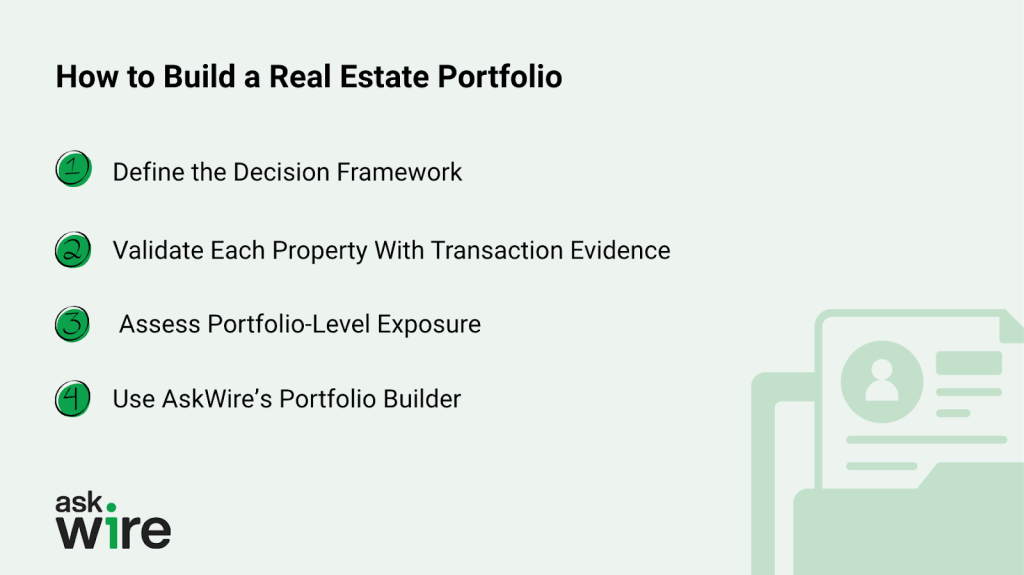
Step 1: Define the Decision Framework
Before evaluating properties, define how decisions will be made.
This step is often skipped because it feels abstract. But without a decision framework, portfolio growth becomes reactive.
Clarity reduces emotional decision-making and strengthens professional control.
Step 2: Validate Each Property With Transaction Evidence
Once the framework is defined, every potential acquisition must be validated with real market data.
This means moving beyond listing prices and projected scenarios. Use Ask Wire and look at:
- Comparable properties that have actually sold
- Realistic rental levels based on completed transactions
- Time-on-market patterns
- Price dispersion within the same micro-market
Step 3: Assess Portfolio-Level Exposure
After validating the property individually, step back.
How does this addition change the overall portfolio structure?
Consider:
- Geographic concentration
- Tenant profile overlap
- Liquidity balance across assets
- Exposure to a single market driver
A property that looks strong in isolation may increase concentration risk at the portfolio level. Without this second layer of review, exposure accumulates quietly.
Step 4: Use AskWire’s Portfolio Builder
As portfolios grow, organization becomes more complex. Comparable references, transaction data, rental assumptions etc.
AskWire’s client management feature is designed to support exactly this need (shameless plug).
Instead of managing information across spreadsheets, emails, and listing portals, agents can:
- Store and organize properties within a structured environment
- Access verified transaction-based comparables
- Review market context in real time
- Prepare defensible portfolio discussions before client meetings
The advantage is not simply access to data, but overall structure.
Here’s a quick inside scoop into how it works:
https://app.storylane.io/share/imqyaxlrkkq3
Looks interesting? Feel free to start your free trial and give it a try yourself!
TL;DR
Building a Real Estate Portfolio is ultra important. To differentiate in the Real Estate market as an agent you need to define a clear decision framework, validate your acquisitions with transaction-based evidence, assess exposure at the portfolio level, and organize everything within a structured environment. If you do that, I promise, growth will become controlled rather than reactive or coincidental.
A Real Estate Agent’s competitive advantage lies between organization and control. These two elements will protect your professional authority.
I hope you enjoyed my article! If you did, feel free to share it with your peers and save it for future reference.