

Real Estate Data Analytics: The Complete 2026 Guide

In today’s rapidly evolving real estate landscape, intuition alone isn’t enough.
Whether you’re a property manager, realtor or developer, you need the right data in order to truly stay ahead of the curve and make the right decisions.
After all, it’s a market that’s constantly shifting so accurate data is – or should be – the underlying structure of every decision you make or answer you give.
At AskWire, we understand real estate analytics better than any other, so let’s dive deeper into our guide and see how our platform can help you out.
What Is Real Estate Data Analytics?
In a nutshell, real estate data analytics is the process of collecting, interpreting, and leveraging large volumes of property-related data to gain insights into market trends, investment opportunities, and risk management.
It combines traditional property knowledge with modern technology, just like AI, machine learning, geospatial mapping, and predictive modeling.
To put it simply, it can answer questions such as:
- What’s a fair price for this property?
- Where should I invest next?
- How is the market likely to evolve over the next 12 months?
The traditional ways of valuing and managing property (gut instinct, simple spreadsheets etc.) are being replaced. And for good reason. Real estate is now a data-driven game.
Here’s why this matters:
- Speed: Markets move fast. Real-time analytics help you keep up.
- Accuracy: Reduce guesswork and minimize costly mistakes.
- Competitive edge: Make decisions faster and with more confidence than your competitors.
With access to high-quality, localized data, stakeholders can reduce risk and seize opportunities that others miss.
For example, let’s assume that you want to invest in a residential property in Athens, Greece. How can you know if the timing is right and which neighborhoods have the best growth potential?
Using AskWire’s real estate data analytics platform, you can:
- View historical price trends in each Athens neighborhood
- Analyze current supply and demand for residential properties in specific areas.
- Compare rental yields, vacancy rates, and market absorption rates.
- Access demographic and infrastructure data (like schools, transport links, etc.) to evaluate long-term desirability.
- Use predictive analytics to see how property values are likely to shift in the next 12 months.
Still wondering how our platform works? Have a go yourself to see its capabilities and how easy it is to navigate the different features:
Simple, right?
Types of Real Estate Data You Can Analyze
Before diving into how to use analytics, let’s break down the types of data most commonly used in real estate:
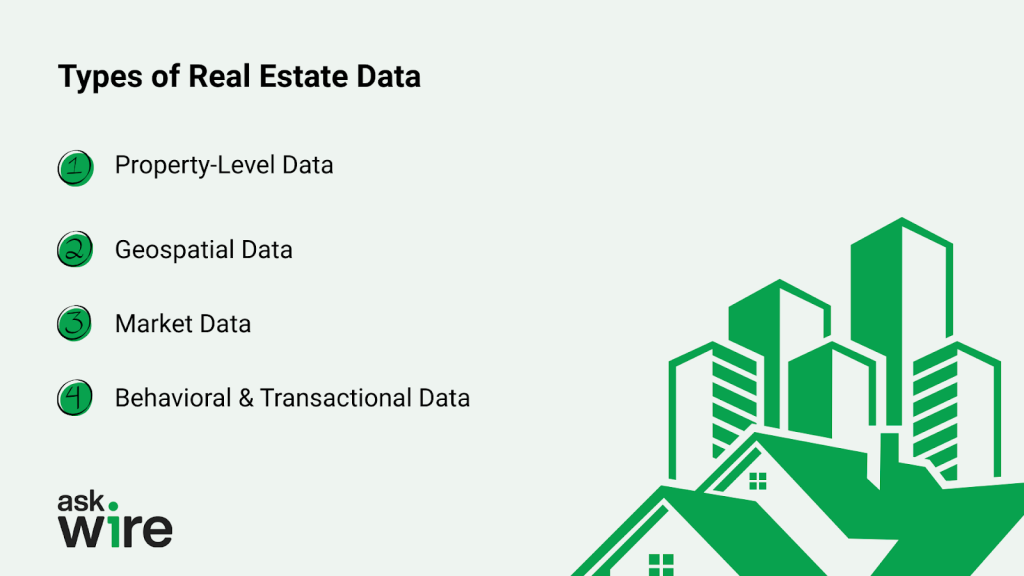
1. Property-Level Data
- Size, age, type, amenities
- Sales history and price trends
- Energy efficiency and compliance ratings
2. Geospatial Data
- Proximity to schools, hospitals, public transport
- Crime rates and neighborhood demographics
- Urban development and zoning changes
3. Market Data
- Rental yields and occupancy rates
- Demand vs. supply indicators
- Seasonal trends and economic indicators
4. Behavioral & Transactional Data
- Buyer preferences and online behavior
- Mortgage application activity
- Transaction timelines and legal bottlenecks
Each of these data types can be integrated into powerful dashboards or models that reveal deeper truths about your property portfolio or target market.
Key Use Cases of Real Estate Data Analytics
Let’s explore how real estate data analytics is applied in practice:
1. Property Valuation
Valuation has always been a critical part of real estate, but now it’s smarter.
Automated Valuation Models (AVMs) pull in dozens of data points to estimate property value in seconds. These models take into account not just nearby sales, but broader market indicators, local economic activity, and even satellite imagery.
Pro tip: Combine AVM results with boots-on-the-ground insights for a more holistic view.
2. Investment Analysis
Investors use predictive analytics to assess potential ROI, rental yields, and price appreciation over time.
So if you want to know whether it’s smarter to invest in Nicosia or Limassol, real estate data analytics can give you the answer.
Data is also what we rely on to create credible and valuable guides, such as our Greek real estate market report for 2025.
3. Risk Assessment
From climate-related threats to neighborhood crime rates, data helps identify risks before they become expensive problems.
You can also monitor legal activity, building code violations, and tenant default risks.
4. Urban Planning & Development
Government agencies and developers rely on big data to plan smart cities, optimize land use, and manage infrastructure investment. Real estate analytics enables data-backed decisions on where to build schools, housing, or commercial centers.
5. Customer Segmentation
For real estate marketing teams, understanding customer behavior is gold.
Data analytics reveals what types of properties are most appealing to specific demographics, thus helping tailor campaigns and offerings for better conversion rates.

Who Needs Real Estate Data Analytics the Most?
Big data and – what looked like – complex analytics was once for big corporations, but not anymore.
Nowadays, professionals like real estate agents can easily take advantage of data analytics, as long as they have the right tools (shameless plug: AskWire).
Let’s who else can benefit from them:
- Investors & developers: they can identify undervalued neighborhoods or upcoming hotspots by analyzing pricing trends, demographic shifts, and infrastructure development
- Banks & financial institutions: Financial institutions rely on analytics to evaluate loan risk more accurately. By layering property-level data with market indicators, they can forecast defaults, adjust lending criteria, and ensure compliance with evolving regulations.
- Insurance companies: Property insurance providers use real estate analytics to assess environmental and structural risks, such as flood zones, wildfire exposure, or earthquake-prone areas.
- Real Estate Agents & Brokers: For agents, analytics provides a data-backed edge in pricing, negotiation, and marketing. By tapping into neighborhood trends, buyer behavior, and historical sales, agents can better advise clients and close more deals.
Let’s wrap things up with some final words.
Final Words
Real estate data analytics empower professionals to move from reactive to proactive and take the right decisions at the right time.
From developers and realtors, to insurers and investors; everyone is in need of data.
At AskWire, we provide everyone with deep and accurate insights at their fingertips!Simply start a free trial and see how AskWire can make your life easier!